


Syllabus: GS2/Governance
In News
- International Data Privacy Day is observed annually on 28th January to raise awareness about the importance of protecting personal data and privacy in the digital age.
- It was designated in 2006 by the Council of Europe to commemorate the signing of Convention 108– the world’s first legally binding international treaty on data protection.
Importance of Data Privacy
- Data privacy is a foundational pillar of responsible digital governance.
- It protects and safeguards citizens’ personal information across large-scale digital public platforms.
- It builds public trust by strengthening confidence in government-led digital services.
- Strong data privacy frameworks promote safe, ethical, and secure digital use, reduce cyber risks, prevent data misuse, and enhance governance through transparency and accountability.
- As digital platforms grow, safeguarding personal data ensures that innovation remains citizen-centric, ethical, and accountable, highlighting the shared responsibility of governments, institutions, and citizens in protecting digital rights.
India’s Expanding Digital Footprint and the Privacy Imperative
- India is now among the world’s most digitalised economies, with the digital economy already contributing over 10% of GDP and projected to reach about one-fifth by 2026–30.
- This growth rides on large-scale digital public infrastructure: Aadhaar-linked identity, UPI-led payments, DigiLocker, and near-universal broadband access.
- Affordable connectivity and over 101.7 crore broadband subscribers have made India one of the most digitally inclusive societies, touching core aspects of daily life such as identity verification, payments, healthcare, and education.
- However, the scale of digitalisation increases privacy and cybersecurity risks, as more sensitive personal data is generated and processed.
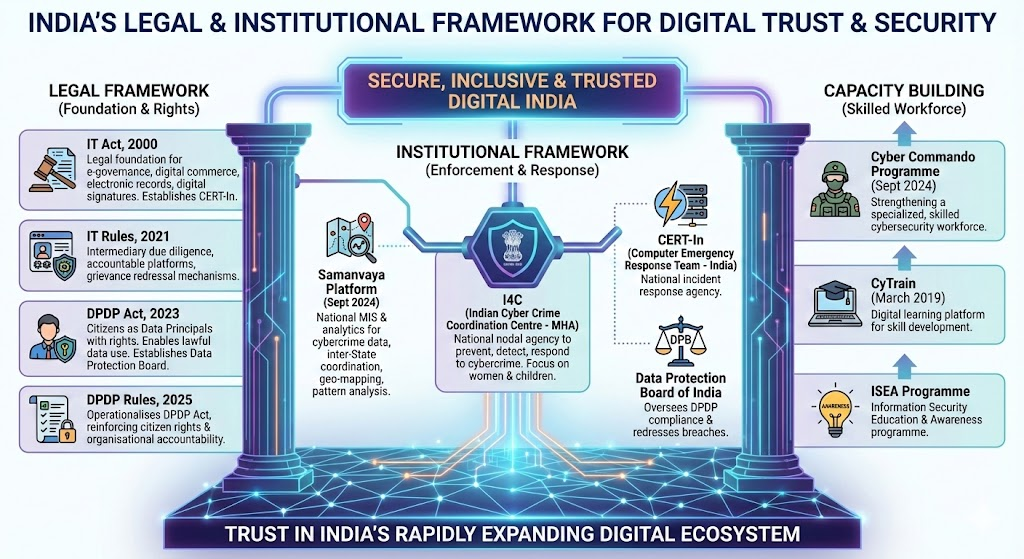
- In response, the government has strengthened data protection and cybersecurity frameworks, including significant budgetary allocations, and emphasises privacy by design, oversight, and accountability.
Democratic and Rights-Based Concerns
- Data protection in India is not just a technical cyber issue but flows from the fundamental right to privacy recognised in Puttaswamy.
- Large-scale welfare and fintech infrastructures (Aadhaar seeding, UPI-linked accounts, digital health and education stacks) create risks of profiling, exclusion, and surveillance if not coupled with strong purpose limitation, oversight, and remedies.
- The DPDP framework has been criticised for wide exemptions for the state, scope for broad “legitimate uses”, and dependence on executive rule-making, which may dilute safeguards in practice.
- Weak institutional capacity, concentration of data in a few state and private platforms, and patchy cyber hygiene further heighten the risk that breaches or misuse could erode citizen trust.
Way Forward
- First, the legal framework must be complemented by stronger independence and capacity of the Data Protection Board, time-bound breach notification, and meaningful penalties even for public authorities.
- Second, privacy-by-design, data minimisation, and decentralised architectures should be built into DPI and sectoral systems (health, education, mobility) rather than treated as afterthought compliance.
- Third, citizens need enforceable rights—easy-to-use consent dashboards, clear grievance channels, and legal aid for data harms—so that “SARAL” is realised in everyday practice.
- Finally, Parliament and regulators must ensure that national-security or innovation narratives do not become blanket justifications to dilute privacy, as a resilient digital economy ultimately rests on public confidence and constitutional values.
Source :TH
Previous article
FTA Concluded Between India and EU
Next article
India’s Paper Industry Push for Easing Forest Rules
